The Good, the Bad, the Ugly of Media Use 9

BestofBestMedia provides so many good things especially for special needs children.  It offers educational programs, a means for those without a voice to have one, and a place to stay in touch with far away family and friends.  It also provides support from others around the world.  This is the good.

However, there is another side to media devices that most of us are aware is bad.  That is the issue of needing to make sure that children learn to interact with others face to face, not just in cyberspace and that they get outside for fresh air and sunshine and exercise.  Many blame media devices for childhood obesity and other illnesses and most parents try to avoid the all day video games many of our children would enjoy.     

Consumer Reports released the results of a survey in May that indicated that 7.5 million Facebook users in the U.S. are under the age of 13, and about 5 million are under the age of 10.  Obviously, this is where things can start to get ugly.  Social networks have been used for bullying by some and others are looking to harm our children in other ways. 

That is why many sources recommend talking to children about the dangers and some suggest being on your child’s friend list.  Others even recommend having their passwords when they first start using social media so you can monitor and help them correct mistakes before they become major.  I see the value of teaching our children to use media responsibly whether they have special needs or not.

Young children certainly need to be monitored when they first start e-mailing, using instant messages, texting, surfing the Internet, using X-Box Live, or joining social networks even when they are thirteen.  Parents also have to monitor television and movie viewing closely especially for young children whether they have special needs or not. 

Those of us with special needs children may actually be better at helping our children avoid the pitfalls than some just because we have had to do this all of their lives.  It is so important that all parents teach their children that the Internet is forever.  Children need to understand that it can’t just be torn up or erased. 

It is the job of parents and educators to teach children responsible use of the Internet.  Children need to understand that there are laws that apply to certain behaviors and that they can destroy their repetition with inappropriate Internet posts.  Anonymity does not really exist for those who break laws as any computer address is traceable.           

Technology is a daily, graded class for sixth graders at my son’s school.  They learn how to safely navigate the Internet, applicable laws that apply to information on the Internet, as well as, how wrong it is to cyber bully someone.  They are accountable for their actions on the Internet, but parents need to remember that until their child reaches legal age, the parent is also accountable.  Maybe we all need a class like this too! 

Education Instead of Force for Real Change 4

Purchased Clip Art Collection Version 1.0 Copyright 2012 Macmanus. All Rights Reserved.

Reasons I Love That’s What I Am

There are so many things I love about the movie, That’s What I Am. My favorite part is when Mr. Simon writes this on the chalk board: Human Dignity + Compassion = Peace. Another wonderful part is when Stanley says, “I can’t make them be nice people and even if I did there would be others to take their place.”  The movie also makes the point that success is about timing, opportunity, and choices. 

Education for Real Change

I hope and pray more people will become tolerant and accepting of differences, but I cannot force them to do this. The best I can do is to continue to try to educate and pray that the message touches hearts. Words said because of fear are just words. Words said because of true change mean so much more.   

I am grateful that this movie reminded me of this. I am also grateful for others who continue to understand that education is so much more powerful than any form of violence will ever be. 

Gratitude for All Who Help

Thank God for all of those who try to make change by living good examples and by educating without cramming information down other’s throats. Thank God for the good teachers who truly inspire. May there be more of them in this world! 

Memorial Day Gratitude 10

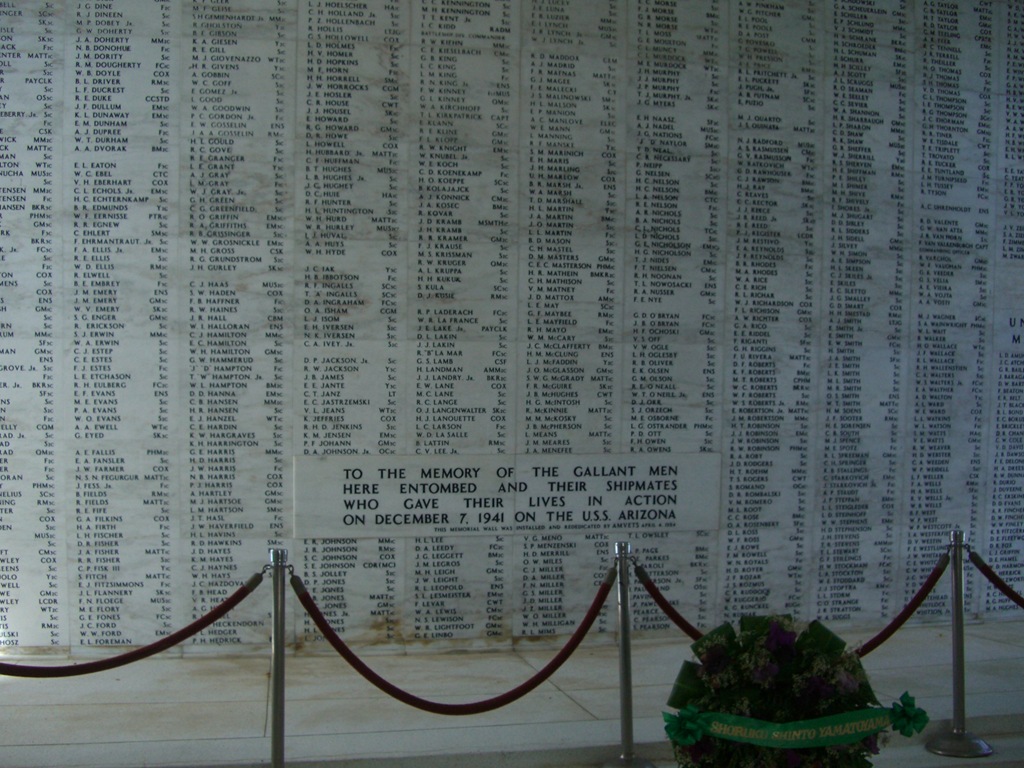
USS Arizona.4 - CopyLooking down on USS Arizona - Copy

The United States celebrates Memorial Day this weekend.  I am grateful to all of the men and women who serve and who have served our country throughout history and to their families.   Today I am sharing pictures from Pearl Harbor since aside from terrorist acts this was the last time war actually touched U.S. soil. 

Please click on the pictures to get a clearer view.  The second picture is looking down on what is left of the deck.  Oil still slowly leaks from the ship so the view is not clear.  Fish now make the ship their home. 

The Gallent Men of The USS. Arizona - Copy

Remains.of.Ship.Today.1 - Copy

The bombing of Pearl Harbor brought the United States officially into WWII.  It directly affected my father as he was already in the army stationed in Panama at the time.  He then fought in the Philippines during the war.  Post-war he remained in the reserves, but he transferred to the air force and was a paratrooper during the Korean War. 

The bombing of Pearl Harbor also profoundly affected my husband’s family.  My father-in-law, a sixth grader at the time, thought the military was doing training maneuvers when he heard the planes so he and his sisters went to the roof of their store to watch.  The smoke coming from Pearl Harbor told the true story.  Even then he did not realize how much it would change his life. 

It would eventually lead to his being sent away to a military high school.  He would stay on the mainland for college and then join the army.  Eventually, he did return to Hawaii to help run the family store, but he missed growing up as a care-free island boy. 

Today I am especially grateful to those who made the supreme sacrifice to protect our freedom and to the families who have suffered the loss of their loved ones through their service to others.        

Forgiveness Defined and Explained: First in How to Forgive Series 18

Definition and Why I Still Need Help

The first definition of forgive in the 2004 version of The Merriam-Webster Dictionary is: to give up resentment of.

I am still learning and growing as I continue to pursue forgiveness. I realized that I still have much to learn when someone once again wounded my loved one. Therefore, I did more research and found a wonderful book, Forgive for Good by Dr. Frederic Luskin

Introduction to Forgive for Good

I am still reading it; however, the first eleven chapters have had a profound effect on me.  I hope by sharing what I am learning others will see the valve of using Dr. Luskin’s techniques too.

The introduction to Forgive for Good explains that forgiveness is about obtaining peace.  It is not for the offender.  Dr. Luskin notes, “forgiveness does not mean that we give up our right to be angry when we have been hurt or mistreated.”  Several things Dr. Luskin states ring so true to me.  One of my favorites is, “Forgiveness is the powerful assertion that bad things will not ruin your today even though they may have spoiled your past.”

Part I

Dr. Luskin divided his book into three sections with Part I focusing on how we all create grievances in response to not getting our needs met and in the process we “rent too much space in our thoughts to disappointment.”  He is not saying anger is never appropriate, instead he explains that, “Anger can be a wonderful short-term solution to life’s difficulties, yet it is rarely a good long-term solution to painful events.”

I also love that he points out that holding others accountable for their actions is not the same as blaming them for how you feel.  Therefore, you can hold someone legally accountable for an injury and still forgive so you can heal.

Part II

Part II explores our choice to forgive.  He makes a point of explaining how we get stuck in being victims and that these stories, “unlike wine, do not improve with age.”  He points out that forgiveness is about changing our story from victim to hero.  We become heroes when we use our stories to heal, to help others or to avoid repeating mistakes.  We then stop using our stories for revenge or to get sympathy.

He dedicates a chapter to the health benefits of letting go of the anger where he mentions four studies he conducted.  The benefits include psychological and emotional well-being.  Another study showed that people who are forgiving are less likely to have a wide range of illnesses.

He also shares stories of families affected by violence in Northern Ireland who took part in the Stanford Forgiveness Project and forgave those who murdered their loved ones.  They should set an example for all of us.  I imagine this is one of the hardest things anyone would ever forgive.

Part III gives techniques to help us with forgiveness which I will explore in a future post since I have five more chapters to read in this section.