Join me in welcoming Robert to my first Effects of Bullying Series.
Robert’s Story
I’m convinced that schools and me were never meant to get on; my trouble with handwriting, spelling and mental mathematics caused a lot of grief. But there was something else present every day, which I detested more: break time.
For me, someone who likes to be forever mentally engaged, break time was the dullest thing ever invented. The other children would talk and play team games like football while I sat in an alcove in the corner of the playground, avoiding the missiles, waiting for the bell to go back inside.
Around nine at the time, an undiagnosed autistic, my interests lay in creativity and making things. I began bringing my creations along with me. So rather than hiding in the corner doing nothing at all, I would work on one of my projects. That’s when the bullying started.
I no longer remember many of the details, but a few students decided that it was a good game to steal and smash-up my creations. Or when they could not steal my stuff, like in class, they would threaten to smash-up my creations, doing hand gestures across the room, like snapping a ruler between clenched fists.
These things represented a great deal of time and effort and I was working with very limited resources and almost no money. Materials and tools were sacred, I worked mainly with what I could find around the house. Breaking, or threatening to break my creations was like breaking a part of me. None of these things could be easily replaced.
Like typical British primary schools, my school was very small; avoiding the bullies was not possible. Nothing the staff did made any noticeable difference and the only friends I had at the time, while great technically minded individuals themselves, were also targets and could do nothing to help. I felt trapped with nowhere to go.
A ray of hope I had been the move to senior school; a completely new set of people and nobody knows me, a chance to start over. The reality was the opposite, even though I had moved beyond lugging projects around a new set of bullies picked up my differences and the bullying started again, but worse.
Instead of focusing on my possessions, this new set of bullies started attacking me personally, kicking, punching and verbal abuse. I was terrified to go anywhere alone, hid in the Special Educational Needs room over breaks and lunch and refused to go anywhere without a support worker for protection.
Combined with the increased demand on handwriting, this meant I was always on edge, always looking for an escape route if something went bad and always ready to meltdown. Unfortunately the latter happened rather a lot, drawing more attention to my differences and making the problem exponentially worse.
These problems and the bullying continued relentlessly. Finally getting a computer eliminated my writing difficulties but the problems only really stopped when I eventually left school and went to college.
Anxiety, fear and constant observation of the environment; always looking for danger, are often cited as symptoms of mild autism. But my own experiences say something different, they are side effects of a difficult childhood.
I have never completely recovered from the bullying in my childhood. While I have been able to overcome my fear of going out alone, I am still very shy and have had no friends to speak of since primary school. My interests and current projects are kept to myself and I’m more likely to accept something as given, or just avoid it altogether, rather than argue.
It gets easier, slowly.
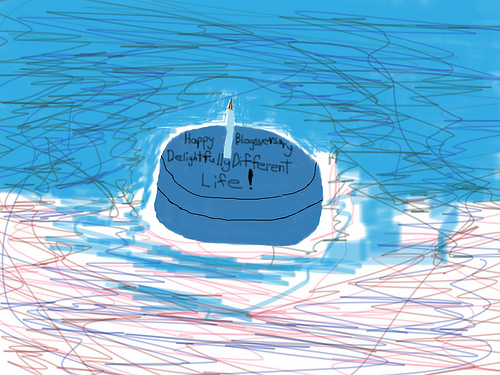 Technically, my blogaversary is September fifth, but who wants to celebrate an anniversary on a Monday or to share it with Labor Day? Not me! So I took the time to play with a new program to bake a cake create a picture for my blogaversary. FYI My daughter did not get her artistic traits from me! Still I did have fun and that is the real point isn’t it?


 Delightfully Different Life